|
Frontpage of GOP-frettir
Forsíða GÓP-frétta
*
*
|
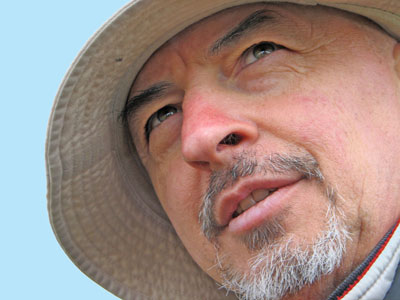
Giancarlo Gianazza |
|
Giancarlo Gianazza
interviewed by
Massimo Bonasorte
Hera Magazine -
November 2006
sent to GOP-frettir by Giancarlo Gianazza
See also on
http://www.renneslechateau.com/forums/viewtopic.php?t=1830 |
|
The interview in English - (Back
to Main) |
Viðtalið á íslensku - (Til
baka á aðalsíðu) |
|
The eradication of the Order of the Knights Templar, ordered by Rome and Phillip
the Fair in 1307, caused a dramatic shift in the ages political and economic
balances. The Knights Templar were mercilessly exterminated, imprisoned,
tortured or burnt at the stake. It was only a matter of time before the warrior
monks became the ghosts of a world no more. Many now believed that all the
followers of the most powerful monastic order of the Middle Ages had been done
away with; in fact, a number of Knights had secretly joined other orders or fled
the more dangerous areas, seeking refuge in countries such as Portugal or
Scotland. |
Uppræting reglu musterisriddaranna að skipun og í samstarfi
Filippusar fríða (og fjórða) Frakkakonungs og Klemensar 5. páfa árið 1307 ollu
miklum sviptingum á stjórnmálalegu og efnahagslegu jafnvægi
álfunnar. Musterisriddurunum var miskunnarlaust útrýmt. Þeir voru fangelsaðir,
pyntaðir og brenndir á báli. Á örskotsstundu voru þessir stríðsmunkar orðnir sem
fulltrúar horfins heims. Margir töldu að allir fylgjendur þessarar öflugustu
munkareglu miðalda hefðu týnt lífi en nokkrir þeirra höfðu á laun orðið liðsmenn
annarra reglna eða flúið frá hættulegustu svæðunum og leitað hælis í löndum eins
og Portúgal og Skotlandi. |
| Not everyone realised that the chosen
Knights the guardians of the Orders gnosis had survived throughout the
centuries, protected by their complete anonymity. But who were these
Knights? What secrets were they guarding? Were they the keepers of the Holy
Grail? And what had they found in the temple of Jerusalem? Most importantly,
where did they hide their treasure? To solve the puzzle, we must consider
that there may be an ulterior link between the frozen plains of Iceland and
the most prominent men of science and art of the age: Dante, Botticelli,
Raffaello and, more than anybody else, Leonardo Da Vinci. |
Fáir gerðu sér grein fyrir því að
útvaldir riddarar - sem gættu þekkingar reglunnar - lifðu ofsóknirnar af og
héldu starfinu áfram um aldir í skjóli fullkominnar leyndar. En - hverjir
voru þessir riddarar? Hverjir voru þeir leyndardómar sem þeir voru að gæta?
Voru þeir að gæta hins heilaga kaleiks? Gralsins? Og - hvað var það sem þeir
höfðu fundið í musterinu í Jerúsalem? Ennþá mikilvægari er spurningin: Hvar
földu þeir það mikla dýrmæti sem þeir gættu? Til þess að leysa þá gátu
verðum við að gera okkur grein fyrir því að til kunna að vera fjarlæg og
falin tengsl milli hinna frosnu háslétta Íslands og merkustu vísinda- og
listamanna aldarinnar - þeirra Dante, Botticelli, Raffaello og - umfram alla
aðra - Leonardo Da Vinci. |
| Does it sound like the plot of some
esoteric fiction movie? Quite the contrary. This is in fact the scenario
that emerges from the discoveries of Giancarlo Gianazza. In his book I custodi del messaggio (The keepers of the
message), written with Gianfranco Ferruglia and published by Sperling &
Kupfer, Mr Gianazza explains his stunning theory, according to which the
greatest men of science and art of the Middle Ages were the keepers of a
secret that they passed down as cleverly coded messages woven into their
major works. A secret relating to the search for the Grail, which
according to Gianazza was concealed in a 5x5m secret chamber by a group
of Knights Templar in the heart of Iceland, with the permission of the local
authorities |
Er þetta ef til vill leyniþráðaflétta í
skáldsögukvikmynd? Nei, þvert á móti. Þetta er í rauninni það sem Giancarlo
Gianazza hefur dregið fram í dagsljósið. Hann útskýrir sína mögnuðu tilgátu
í bók sinni I custodi del
messaggio sem á íslensku útleggst sem Verðir skilaboðanna. Bókin
er skrifuð af Gianfranco Ferruglia og gefin út af Sperling & Kupfer. Þar
lýsir Giancarlo Gianazza hvernig framúrskarandi menn miðalda gættu leyndarmálsins og ófu
úthugsaðar vísbendingar í sín mikilhæfustu verk til að koma upplýsingunum
áfram til eftirkomenda. Upplýsingum sem tengjast leitinni að hinum heilaga
gral - sem samkvæmt Gianazza - var varðveittur í 5x5m leynirými inni í
hjarta Íslands - og var fluttur þangað með leyfi þeirra sem þar réðu þá
málum. |
| But what does the Divine Comedy have to
do with all this? Well, according to Gianazza, Dantes masterpiece is a
coded account of an actual trip the supreme poet made to Iceland, possibly
in 1319. At the end of the Divine Comedy Dante stands before the so-called
White Rose of the Blessed, where Beatrice sits. The image depicted in
Dantes verses is somehow factual, as it corresponds to a natural
amphitheatre near the Jökulfall river. It would appear that during his final
quest in Iceland, Dante did indeed find that natural amphitheatre and much
more. Experts have established that the subsoil features where Dante located
the secret chamber match this theory. Tests performed with state-of-the-art
measuring, prospecting and tomography devices all point in the same
direction. Finally, hidden in the profiles of the characters of Leonardos
Last Supper is a map showing the course of the Jökulfall river. The map can
be discovered only by correctly decoding the path along which Dante follows
Matelda to Beatrice in the garden of Eden. |
En - hvernig snertir þetta
Hinn guðdómlega Gamanleik?
Samkvæmt Gianazza er þetta meistaraverk Dantes flétta sem geymir
vísbendingar sem eru lýsing á ferð sem þetta stórskáld fór til Íslands -
sennilega árið 1319. Í lok hins guðdómlega Gamanleiks stendur Dante
frammi fyrir hinni svonefndu Hvítu Rós hinna Blessuðu
þar sem
Beatrice situr. Myndin sem Dante þar dregur styðst við staðreyndir þar sem
hann lýsir stað í gljúfrum Jökulfalls nærri Kerlingafjöllum þar sem nota
mætti lýsingu eins og stórt hringleikahús þar sem gólfið er sléttstreymandi
yfirborð árinnar. Svo virðist sem Dante hafi hafi fundið þennan stað og
margt fleira.Sérfræðingar hafa staðreynt að við tilgátu Gianazza ríma
jarðvegseinkenni þessa staðar þar sem Dante fann leynihvelfinguna.
Rannsóknir á staðnum renna einnig stoðum undir tilgátuna. Auk þess er kort
af svæðinu við Jökulfallið falið í útlínum einstaklinga í mynd Leonardo da
Vinci Síðasta kvöldmáltíðin. Kortið kemur þó ekki í ljós nema fylgt
sé göngu Dantes þegar hann eltir Matelda til Beatrice í Eden. |
| Gianazzas fascinating
arguments are explored in the following interview and open up a
ground-breaking approach to the study of esoteric knowledge, not only in the
Middle Ages but in other times as well. |
Hrífandi rökstuðningur
Gianazzas er skoðaður hér á eftir en hann opnar alveg nýja nálgun við
rannsókn dulfræða bæði á miðöldum og síðar. |
| What pushed you to undertake this
quest? |
Hvað varð til þess að
þú ákvaðst að ráðast í þetta verk? |
| It all began one time when I was looking
at Botticellis Spring. I noticed there was a number code in the painting.
At first I simply wanted to figure out the concealed number. After a months
hard work I realised it was a date: March 14, 1319. My curiosity was roused
I wanted to learn what the date meant. |
Þetta byrjaði allt þegar ég eitt sinn var
að skoða Vorið eftir Botticelli. Ég tók eftir því að það voru
talnatákn í málverkinu. Fyrst langaði mig bara að finna út hinar
tilvísuðu tölur. Eftir að hafa legið yfir því í hálfan mánuð gerði ég mér
grein fyrir að það var dagsetning: 14. mars árið 1319. Þar með
vaknaði forvitni mín. Ég vildi finna út hvað þessi dagsetning átti að tákna. |
| One thing was for sure: Botticelli wanted
to communicate something. After five centuries, number decoding was making
it possible to come into contact with the artists most secret thought. I
wanted to understand why Botticelli did it, so I decoded other paintings of
his and found consistent reference to Dantes Divine Comedy. By then I knew
I was on to something: Botticelli was saying, I have painted what is coded
into the Comedy. So the next step was to decode Dantes masterpiece. And
thus my quest began. |
Það var alveg ljóst að Botticelli ætlaði
myndinni að koma skilaboðum áleiðis. Núna, fimm hundruð árum eftir að myndin
var máluð, varð þessi talnagreining til þess að unnt gat verið að komast nær
þeim leyndardómi sem búið hafði í huga listamannsins.
Ég vildi skilja hvers vegna Botticelli gerði þetta og þess vegna skoðaði
ég aðrar myndir hans og fann að í þeim vísaði hann stöðugt í guðdómlega
Gamanleik Dantes. Þá vissi ég að ég var kominn á sporið.
Botticelli var að segja: Ég hef málað það sem fléttað er í Gamanleikinn.
Næsta verk var því að lesa í boðskap Dantes. Þar með var ég lagður af stað. |
| What kind of code is it? |
Hverslags tákn eru
þetta? |
|
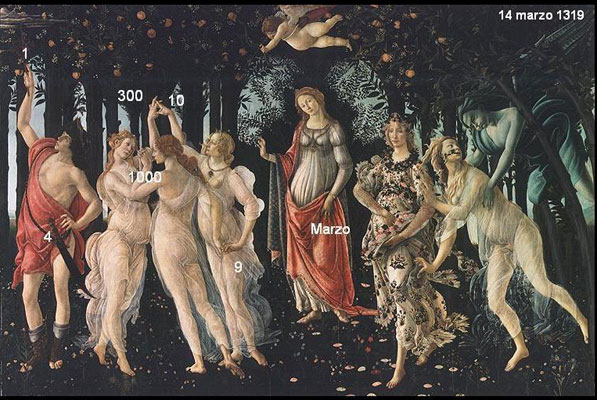
A mysterious date
Looking carefully at the group of the Graces I wondered why the position of
the fingers was so strange.
From that detail began my first attempt to interpret the painting with a
code
that led me to identify a precise date: 14 March 1319
Dularfull dagsetning
Þegar ég skoðaði gyðjuþrenninguna nánar þótti mér staða fingranna
sérkennileg.
Út frá því atriði upphófst fyrsta tilraun mín til að ráða í merkingu
málverksins
með táknmáli sem að lokum leiddi mig að dagsetningunni: 14. mars árið 1319. |
| The first code I figured out in
Botticellis Spring is digital, in its aboriginal meaning: numbers expressed
using finger language. The code refers to the gestures the mediaeval monks
used in order not to disturb meditation and break the Benedictine oath of
silence. The monks would resort to this code whenever they needed to
communicate for practical purposes.
Since I had no access to the codes of
the time, I had to proceed by trial and error. Not very scientific, but it
paid off. |
Fyrstu táknin sem ég rakst á
í Vori Botticellis eru tölur táknaðar á fingramáli. Táknin eru þau
sem munkar miðalda notuðu til að trufla ekki hugleiðslu og komast hjá því að
brjóta þagnareið Benediktusar. Þeir notuðu aðferðina til að skiptast á
upplýsingum sem tengdust daglegum störfum þeirra.
Þar sem ég hafði engan aðgang að táknfræði þeirra tíma
varð ég að þreifa mig áfram og reka mig á. Þetta var ekki mjög vísindalegt -
en það skilaði árangri.
|
| Remember that if a person decides to pass down a coded message, he
or she will use more than one means to ensure that anyone trying to decode
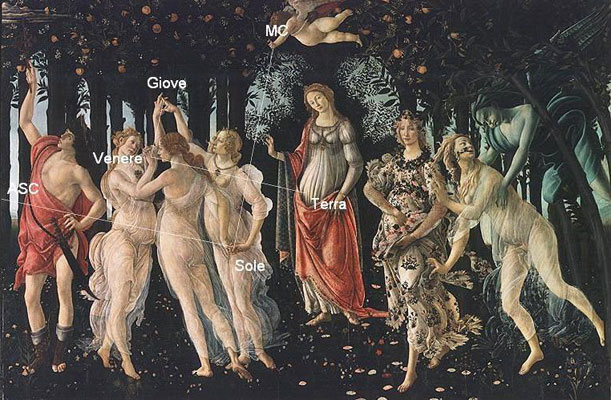
the message can interpret it correctly. Well, Botticelli also used an
astronomic code, as it were. He painted in the morning of that very day by
depicting the relative angular positions of the seven planets known at the
time. |
Nauðsynlegt er að gera sér grein fyrir því að sá sem
hyggst koma til skila tilteknum boðum verður að nota fleiri en eina aðferð
til þess að vera viss um að hver sá sem reynir að lesa boðin geti túlkað þau
á réttan hátt. Botticelli gerði það með því að nota stjörnufræðitákn. Hann
málaði morgunn þessa dags með því að sýna innbyrðis horna-afstöðu þeirra sjö
reikistjarna um sólina sem þá voru þekktar. |
|
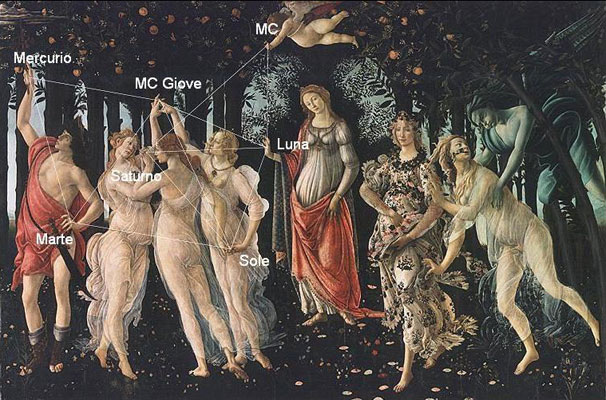
The geometric scheme of the angles among the planets at the dawn of the
same day: 14 March 1319.
Þverskurður hornanna milli reikistjarnanna þennan sama dag: 14. mars árið
1319.
 |
| Thats not all: the same date is in the
Divine Comedy as well. Everyone agrees that in the first verses Dante refers
to a spring equinox. So far, however, nobody had realised that the planet
that forges the human souls (v. 41-42) and is rising with the Sun during
this equinox is Saturn. Now, Saturn is in conjunction with the Sun only once
every thirty years, so the conjunction must have occurred in 1289, 1319 and
1349. Dante wrote the Divine Comedy between 1300 and 1321, so the date
indicated in the first verses of Paradise must be March 14 1319. |
Sama dagsetning er einnig
í guðdómlega Gamanleiknum. Allir eru sammála um að fyrstu versunum
vísi Dante til jafndægurs á vori. Fram til þessa hafði hins vegar enginn
gert sér grein fyrir því að stjarnan sem mótar mannshugann (vers
41-42) og er rísandi á þessu jafndægri er Satúrnus. (GÓP: Sjá nánar
á Wikipedia um hugmyndir stjörnuspekinnar um áhrif Saturnusar á
mannshugann). Í raun rís Satúrnus með sólu aðeins á þrjátíu ára fresti.
Það merkir að þessi viðburður hlýtur að hafa orðið árið 1289 eða 1319 eða
1349. Dante skrifaði guðdómlega Gamanleikinn á árunum frá 1300 til
1319. Dagsetning fyrsta versins um Paradís hlýtur því að vera 14. mars árið
1319. |
| This is the part of the Comedy in
Botticellis Spring: we are still in the garden of Eden and after the rite
Dante is pure and ready to rise to the stars. |
Þetta er hluti
Gamanleiksins í Vori Botticellis: Við erum enn í garðinum Eden og
eftir helgiathöfnina er Dante orðinn syndlaus og reiðubúinn að hefjast til
stjarnanna. |
| Are there any astronomic
correspondences in the Divine Comedy? |
Eru einhverjar
stjörnuspekivísanir í Hinum guðdómlega Gamanleik? |
| Certainly. For instance, Dantes date of
birth is concealed in two tercets (v. 112-117) of canto XXII of the third
part, which includes tenth-of-degree accurate reference to the position of
the planets on June 13 1265. |
Vissulega. Til dæmis er
fæðingardagur Dantes fólginn í tveimur þríhendum (vers 112-117) í kafla XXII
í þriðja hlutanum þar sem er að finna tilvísun til afstöðu stjarnanna hinn
13. júní árið 1265 - með nákvæmni upp á einn tíunda úr gráðu. |
| But the issue is another one. Why did
Dante choose to conceal his birthday in his greatest work and not simply
state it directly? I believe he wanted us to discover it, because in my
opinion he wanted to provide the clues to understand his code. Once youve
figured out his birthday you have the key to the structure of the entire
code used to conceal much more significant information. |
Á þessu er hins vegar
önnur markverð hlið. Hvers vegna kaus Dante að hylja fæðingardag sinn í sínu
mesta stórvirki - í stað þess einfaldlega að skrifa hann með venjulegum
hætti?
Ljóst er að hann leggur þetta tiltölulega einfalda
verkefni fyrir lesandann í sérstökum tilgangi. Sá lesandi sem áttar sig á
því að hér er boðskapur fólginn - getur lesið úr honum og - með upplýsingum
annars staðar frá um fæðingardag hans - sannfærst um að hafa lesið rétt í
tilvísanirnar - hefur þannig fengið lykil að því tilvísanakerfi sem Dante
notar til að geyma miklu merkilegri upplýsingar. |
| Are there space indications as well as
time indications? |
Er vísað bæði til staða
og tíma? |
| The time indications have been cleverly
coded into the work. They allow the accurate marking of a specific moment
regardless of varying calendar customs. A similar criterion was used to
indicate geographic distances a criterion that relies on universal
parameters and not on local measurement units. The method used refers to
longitude and latitude. As regards the former, the meridian of reference is
the one passing through Jerusalem; as regards the latter, the parameters are
exactly the same as ours: the equator and the Arctic circle. |
Tímavísanirnar hafa verið
fléttaðar inn í verkið með úthugsuðum hætti. Hver þeirra gefur nákvæma vísun
til ákveðinnar stundar óháð því hvernig dagatali lesandans er háttað.
Svipaðar aðferðir eru notaðar til að tiltaka vegalengdir. Þar eru notaðar
altækar viðmiðanir en ekki sértækar mælieiningar. Aðferðin miðast við
lengdar og breiddarbauga rétt eins og nú. Eini munurinn er sá að núllbaugur
í þessu kerfi er hugsaður dreginn um Jerúsalem. |
| Where does Leonardo come into play? |
Hvar kemur Leonardo í
leikinn? |
| After a year spent working on Botticelli
and Dante I realised that they could not have been alone in all of this. To
substantiate my findings I needed further evidence, particularly in works of
pictorial art. Since Leonardo, as a boy, had worked in Verrocchios studio
the same as Botticelli it seemed plausible that Leonardo might have
received the same up-bringing and partaken of the knowledge of the Divine
Comedy. And indeed, Leonardos paintings feature the same type of code used
in Botticellis works. |
Þegar ég hafði notað eitt
ár í að rannsaka Botticelli og Dante gerði ég mér grein fyrir því að þeir
gætu ekki verið tveir einir í þessu verki. Til þess að renna fleiri stoðum
undir ályktanir mínar þyrfti ég að finna fleiri samhljóma vísanir - einkum
úr myndverkum. Þar sem Leonardo hafði í æsku starfað í myndveri Verrocchios
eins og Botticelli virtist líklegt að hann hefði hlotið sama uppeldi og sömu
þátttöku í vitneskjunni um guðdómlega Gamanleikinn. Við nánari skoðun
kom í ljós að málverk Leonardos geyma sömu tegund tilvísana og verk
Botticellis. |
|
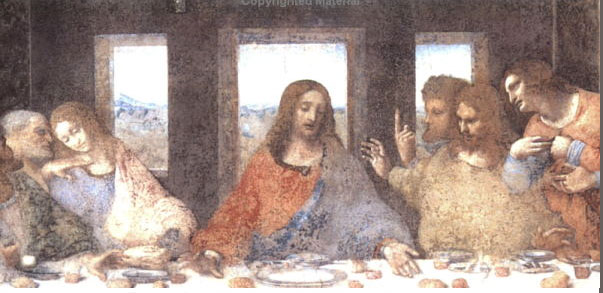
Leonardo da Vinci: The Last Supper - Síðasta kvöldmáltíðin. |
| Tell us more about the anomalies in
the Last Supper. |
Segðu okkur meira um
frávikin í Síðustu kvöldmáltíðinni |
| The bread that Jesus indicates with his
left hand is not made in accordance with Hebrew dictates. It is a loaf,
whereas a table laid for Passover should have unleavened bread on it the
type of bread eaten by the Jews during the eight days of celebration of
their passage from slavery to freedom, their Exodus from Egypt under Moses
guide. |
Brauðið sem Jesús vísar
til með vinstri hönd er ekki gert eins og fyrirskrifað er í hebreskum
sið. Það er gerlyftur brauðhleifur. Á hátíðarborði páskanna hefði hins vegar
átt að vera gerlaust brauð - eins og venja er hjá Gyðingum á þessari
átta daga hátíð til minningar um brottför þeirra frá Egyptalandi - ferðinni
úr þrældómi til frelsis undir leiðsögn Mósesar. |
| How can Leonardo have made such a
mistake in his most important work? Is it really a mistake? Or is there more
to it? |
Hvernig getur Leonardo
hafa gert slík mistök í sínu merkasta verki? Eru þetta í raun mistök eða býr
fleira undir? |
| Theres no questioning Leonardos extreme
care for detail; therefore, I dont believe he made a chance mistake in
fact, I think the mistake is there on purpose to provide the discerning
observer with a very specific clue. Leonardo wanted to draw attention to the
bread; in it, he concealed three indications. These indications, decoded on
a cartographic basis, show three European locations: the Greek island of
Kythira, Mount Cardou (France) and a place in the heart of Iceland. Using
unleavened bread, which is flat, this would not have been possible. |
Alþekkt er sérstök
nákvæmni Leonardos um hvert smáatriði svo að engar líkur eru á að honum hafi
orðið á einhver óvart mistök. Ég hygg að þessi mistök séu
gerð í þeim tilgangi að vekja athygli glöggs athuganda á sérstakri
vísbendingu. Leonardo vildi draga athyglina að brauðinu. Þar lagði hann inn
þrjár vísbendingar. Þegar þessar bendingar hafa skilist og verið
lesnar á kortagrunni sýna þær þrjár staðsetningar í Evrópu: grísku eyjuna
Kythira, fjallið Mont Cardou í Frakklandi og stað í hjarta Íslands. Ef hann
hefði notað flatt, óhefað brauð, hefði þetta ekki verið hægt. |
| The interesting thing is that the ratio
of the distances expressed in degrees between Mount Cardou and Jerusalem
and between Iceland and Mount Cardou is such that you can indicate the
position of these locations with two adjacent squares the sides of which are
in a two-to-three ratio. These two adjacent squares are the summation of a
secret: the exact position of the location in Iceland in relation to
Jerusalem. I have noticed these patterns in many of Leonardos paintings. |
Hlutföll fjarlægðanna í
gráðum milli Mont Cardou og Jerúsalem og milli Íslands og Mont Cardou eru
þannig að unnt er að tákna þessar staðsetningar með tveimur samlægum
ferningum sem eru í stærðarhlutföllunum tveir á móti þremur. Þessir samlægu
ferningar geyma til samans leyndarmálið: nákvæma staðsetningu á Íslandi
miðað við Jerúsalem. Þetta munstur hef ég fundið í mörgum verkum Leonardos. |
| Where does Iceland fit into the code? |
Hvar kemur Ísland fyrir
í þessum vísbendingum? |
| The message coded into the Divine Comedy
tells us that Dante himself went to Iceland. If you think it sounds strange,
remember that there is documented evidence that pilgrimages from Iceland to
Rome and the Holy Land were taking place as early as the 12th century, so
there is no reason why Dante should not have made the journey the other way.
And Dante did indeed visit Iceland, probably in 1319. |
Skilaboðin sem lesin verða
úr guðdómlega Gamanleiknum segja okkur að Dante fór sjálfur til
Íslands. Ef þér finnst það hljóma undarlega skaltu hafa í huga að pílagrímar
frá Íslandi fóru til Rómar og til landsins helga að minnsta kosti frá 12.
öld. Það er því ekkert sem mælir gegn því að Dante hafi getað farið hina
leiðina - frá Róm til Íslands. Dante fór raunverulega til Íslands -
sennilega árið 1319. |
|
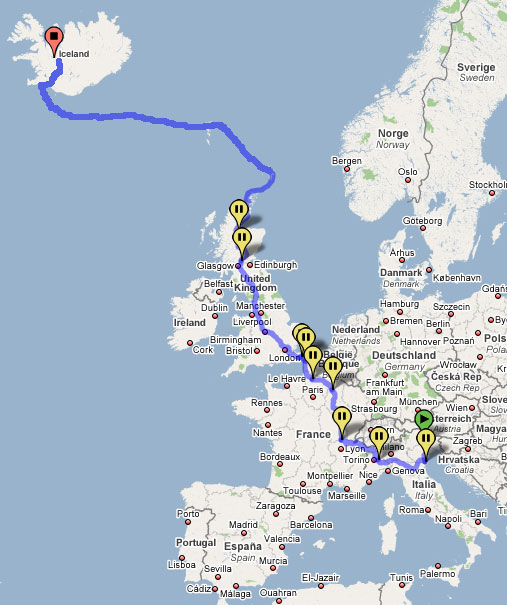
Dante´s trip to Iceland - 1319 - Ferðaleið Dantes til Íslands |
| The description of the journey is coded
into canto XXVII of the Purgatory. Here, Dante passes through Luni, Sarzane,
the Stura Valley and Colle della Maddalena; he enters the territories of the
French king at Macon, passes through Reims and Amiens, boards a ship an
Strouanne and arrives in Dover, carries on to Stirling Castle in Scotland
and then to Iverness, where he boards a boat to the Shetland Islands and
finally to Iceland. |
Ferðalýsingin er fólgin í
kafla XXVII í Hreinsunareldinum. Dante fer um Luni, Sarzane, Stura-dalinn,
og Colle della Maddalena. Hann fer inn á umráðasvæði Frakkakonungs við
Macon, fer um Reims og Amiens, um borð í skip í Strouanne og siglir til
Dover. Þar fer hann áfram til Stirling kastala í Skotlandi, þaðan til
Inverness þar sem hann fer á báti til Shetlandseyja og loks þaðan til
Íslands. |
|
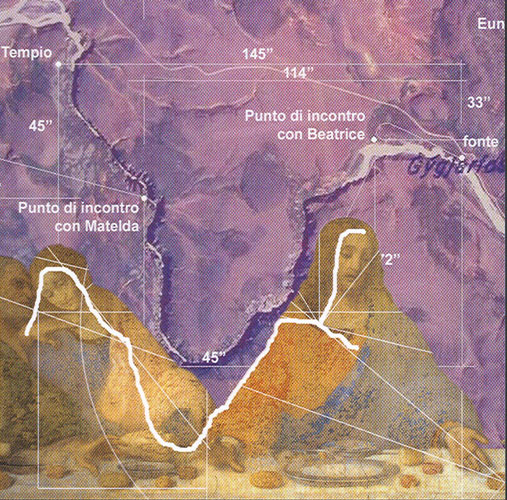
Hluti af mynd Leonardo felldur inn á loftmynd af miðbiki
Íslands.
Hvað tengir Dante Alighieri og Leonardo da Vinci?
Hver er leynilegi boðskapurinn sem gengur gegnum hin frægu verk,
Gamanleikinn og Síðustu kvöldmáltíðina? |
| When he eventually reaches the
amphitheatre of the White Rose of the Blessed, he observes it as a pilgrim
redeeming himself as he beholds the temple he has pledged to visit. Dante
is referring to the natural amphitheatre near the Jökulfall river. In the
amphitheatre there is a very particular stone, shaped just like a throne
the seat of Beatrice. In another tercet Dante tells us that about 20 m
behind the stone there is a secret chamber: the Temple. |
Þegar hann að lokum kemur
að vatns-hringleikasvæði Hvítu Rósar hinna Blessuðu skoðar hann það
eins og pílagrímur sem endurmetur sjálfan sig þegar hann hefur náð
þeim helgistað sem hann hefur heitið að sækja heim. Dante vísar til
náttúrulegs vatns-hringsviðs við ána Jökulfall. Þar er að finna afar
sérstakan stein sem er í laginu eins og höfðingjasæti - sæti Beatrice. Í
annari þríhendu segir Dante okkur að um 20 metrum bak við sæti Beatrice sé
leynirúm: Musterið. |
| If your theory turns out to be
correct, it will be an amazing discovery. How is the on-field research
going? |
Ef tilgáta þín reynist
á rökum reist er þar á ferðinni stórkostleg uppgötvun. Hvernig miðar
rannsóknum á svæðinu? |
| Last year I located the area Dante
indicated a 13x13m (1" longitude) square. This year we worked on the
prospecting. In July I went to Iceland with two geophysicists, Gianfranco
Morelli from Livorno and Douglas Labrecque from Nevada, and a geologist,
Mario Ferguglia from Turin. Together we carried out georadar and electric
tomography measurements. The data show that the area presents an anomaly
matching my theory. Hopefully the Icelandic authorities will allow me to
carry on with the excavations. |
Í fyrra (árið 2005)
afmarkaði ég svæðið sem Dante vísar til. Það er 13x13m ferningur sem
samsvarar 1"-ferningi á lengdarskala málverksins. Í ár unnum við að frekari
rannsóknum. Í júlí fór ég til Íslands ásamt tveimur jarðeðlisfræðingum, þeim
Gianfranco Morelli frá Livorno og Douglas Labrecque frá Nevada, og Mario
Ferguglia, jarðfræðingi frá Turin. Við framkvæmdum sneiðskoðanir á jarðvegi
með jarðradar- og raftækjum. Niðurstöðurnar sýna að um er að ræða frávik sem
eru í samræmi við tilgátuna. Vonandi heimila íslensk yfirvöld mér að
rannsaka svæðið til fullnustu. |
|
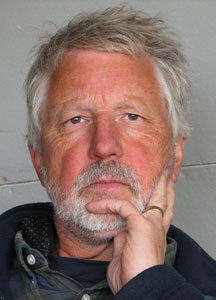
Þórarinn Þórarinsson, arkitekt, í júlí 2007.
Í stjórn Arkitektafélagsins frá 2002 til 2005
þar af formaður tvö síðustu árin.
|
| And theres more. The Icelandic
authorities have put me in touch with Thorarinn Thorarinsson, the president
of the Icelandic order of architects and an expert of local history. Mr
Thorarinsson has provided me with a further, very mysterious element. He has
told me that in the official historic records of Iceland it is stated that
in 1217, during the meeting of the Althing the Parliament established in
930 the leader and poet Snorri Sturlusson appears next to what the text
defines 80 knights from the south, all dressed and armed in the same
fashion and is elected as commander for that year.
Nowhere else in
Icelandic history is there such a unique event. It is a sheer anomaly.
Historians do not know who these knights from the south are, nor do they
know what their role was in the election of Sturlusson. When I got in touch
with Mr Thorarinsson, telling him that something had been hidden in the
heart of Iceland in the 13th century, the link with the Knights Templar was
immediate. I am convinced that in 1217 a group of Knights Templar travelled
to Iceland and backed the election of Sturlusson in exchange for his support
in the building of a secret chamber to be filled over the years with sacred
books and objects from the Temple of Jerusalem. |
Hér er nokkru við að bæta.
Íslensk yfirvöld hafa komið mér í samband við Þórarinn Þórarinsson arkitekt
sem er sérfræðingur í sögu Íslands. Hann hefur upplýst mig um enn eitt mjög
dularfullt sögulegt atriði. Hann hefur sagt mér að í fornum íslenskum heimildum
segi frá því að á alþingi Íslendinga sem stofnað var árið 930 - hafi árið
1217 leiðtoginn og skáldið Snorri Sturluson verið fjölmennur "og voru
átta tigir Austmanna í flokki hans alskjaldaðir".
(GÓP: Sturlunga saga,
1909, kostnaðarmaður Sigurður Kristinsson. Annað bindi, á bls. 72 í kafla 39
á bls. 70 - 73. Sjá textann hér í fullri lengd hér
fyrir neðan.)
Hvergi annars staðar í sögu
Íslands er getið slíks atburðar. Hann er þar ólíkur öllum öðrum skráðum
atburðum. Sagnfræðingar vita ekki hverjir þessir menn voru eða hvert þeirra
erindi var í flokki Snorra til alþingis. Þegar ég komst í samband við
Þórarinn og sagði honum að hlutir hefðu verið faldir í Íslandi á þrettándu
öld tengdust þeir í hugum okkar strax við Musterisriddarana. Ég er
sannfærður um að árið 1217 hafi hópur þeirra farið til Íslands og stutt
Snorra og í staðinn notið liðsinnis hans við að útbúa leynirými þar sem
síðar var komið fyrir bókum og munum úr Musterinu í Jerúsalem. |
| I believe that the chronological journey
matches that described by Leonardo, where the treasure is found by the
knights around 1125, partly in Jerusalem and partly in Citera, transferred
to France and finally hidden in the underground chamber in Iceland, little
more than a century later. |
Ég tel að tímasetning
ferðarinnar sé í samræmi við það sem Leonardo lýsir sem fundi hinna dýrmætu muna
um 1125, að hluta til í Jerúsalem og að hluta til í Citera, flutningi þeirra
til Frakklands og að lokum felum þeirra í neðanjarðarrými á Íslandi rúmlega
einni öld síðar. |
| Where does Raffaello fit in? |
Hvar kemur Raffaello
til sögunnar? |
| I believe Raffaello was involved by
Bramante. Leonardo coded much information into the Last Supper but must have
realised that his work could be jeopardised and his message lost because of
the terrible flood that struck Milan in 1500. My theory is that Leonardo
expressed his worries to his friend Bramante, who may have suggested to
Leonardo to give him his codes so that he could pass them on to others; this
way, the message and the codes could survive throughout the centuries. So
with the help of Bramante, Raffaello coded all the information into the
frescos of the Stanza della Segnatura. The twelve paintings can be read on
the basis of a single underlying theme: the Divine Comedy. |
Ég tel að það hafi verið
Bramante sem fékk Raffaello til liðs við verkefnið. Leonardo fól mjög miklar
upplýsingar í Síðustu kvöldmáltíðina en hann hlýtur að hafa gert sér
grein fyrir því að skilaboð hans kynnu að fara forgörðum í hinum miklu
flóðum sem urðu í Mílanó árið 1500. Ég hugsa að Leonardo hafi tjáð Bramante,
vini sínum, áhyggjur sínar. Bramante hafi síðan tekið að sér að koma
tilvísununum og skilaboðunum til annarra sem gætu séð um að þær skiluðu sér
til komandi tíma. Þannig hafi það orðið að Raffaelli naut aðstoðar Bramantis
til að flétta allar upplýsingarnar inn í freskurnar í Stanza della
Segnatura. Í þau tólf málverk má lesa eitt grunnþema: hinn guðdómlega
Gamanleik. |
| What is the link between Leonardo,
Iceland and cartography? |
Hvaða tengsl eru milli
Leonardos, Íslands og kortafræði? |
Canto XXXIII of the Purgatory reads:
Dorme lo ngegno tuo, se non estima
per singular cagione essere eccelsa
lei tanto e sì travolta ne la cima
(Thy reason slumbers, if it deem this
height and summit thus inverted of the plant without due cause, trans. by
Rev. H. F. Cary).
It appears that Dante is talking about the part of the
plant in Eden. A plant with an unusual shape. He describes how the plant
opens up at the top and is slit across the summit.
Now, if we read the
original tercets literally and not allegorically, the verses take on an
entirely different meaning.
I asked myself what kind of plant could have its
height and summit thus inverted. If we use a cartographic code, we can see
that the expression
´.............. eccelsa
lei tanto ..............
(literally, so extraordinarily
high)
refers to a place at a very high latitude. The numbers of the verse
(66) and of the canto (33) correspond to the latitude of the Arctic circle
(66°33). Now, what is that place so extraordinarily high, i.e. so far
north, and thus inverted near the Arctic circle? It can only be Iceland,
which opens up to the north with two peninsulae and is precisely touched on
the eastern one by the Arctic circle. |
Í kafla XXXIII í
Hreinsunareldinum segir:
Dorme lo ngegno tuo, se non estima
per singular cagione essere eccelsa
lei tanto e sì travolta ne la cima
(Rökskyn þitt dottar ef það lítur til þessarar
umhverfðu hæðar og hátopps plöntunnar án þess að kafa dýpra eftir
skynsamlegum skýringum - GÓP þýddi úr enska texta
séra H.F.Cary.)
Svo virðist sem Dante sé að tala um hluta plöntunnar í Eden. Plöntu sem
er óvenjuleg í laginu. Hann lýsir hvernig plantan opnast í toppinn og er
rist sundur þar sem hún fer hæst. Ef við hins vegar lesum upphaflegu
þríhendurnar orðrétt en ekki með þeim hætti sem þær hafa hingað til verið
útskýrðar þá skipta þær algerlega um merkingu. Ég spurði sjálfan mig
hverslags planta gæti verið með sína hæð og hápunkt þannig umhverft.
Ef við notum kortafræðilegar vísanir sjáum við að yrðingin
............ eccelse
lei tanto ........
(orðrétt: afbrigðilega hár) vísar til staðar sem er á afar hárri
breiddargráðu. Númer versins (66) og kaflans (33) vísa til breiddargráðu
heimskautsbaugsins (66o33'). Hvaða staður er þá það sem er svo
afbrigðilega hár þ.e. langt til norðurs og þannig umhverft við
heimskautsbauginn? Það getur aðeins verið Ísland sem opnast til norðurs með
tvö nes og það eystra snertir nákvæmlega heimskautsbauginn.
|
| But why Iceland? |
En hvers vegna Ísland? |
| For two reasons: first, Iceland was the
most distant land known in Dantes time. It must have seemed like the
perfect hiding place. Second, among the nine Knights Templar who made the
discovery at the Temple of Jerusalem there was a member of the Sinclair
family, of Scottish descent. The family owned the Orkney Islands, from which
one could sail to Iceland in a matter of days. It seems reasonable to assume
that the Sinclair family chose Iceland as the stronghold of the Jerusalem
discoveries. |
Til þess liggja tvær
ástæður. Sú fyrri er að Ísland var nyrsta landið sem þekkt var á tíma
Dantesar. Það hefur því þótt heppilegur felustaður. Hin ástæðan er sú að
meðal hinna níu Musterisriddara sem fundu gripina í Musterinu í Jerúsalem
var einn meðlimur Sinclair-fjölskyldunnar sem átti ættir að rekja til
Skotlands. Fjölskyldan átti Orkneyjar og þaðan mátti sigla til Íslands á
fáeinum dögum. Það er nærtækt að álíta að Sinclair-fjölskyldan hafi valið
Ísland sem geymsluvirki fyrir gripina frá Jerúsalem. |
| So what is the actual link between
Dante and the Knights Templar? |
Hver er þá hin
raunverulega tenging milli Dante og Musterisriddaranna? |
| After the Knights Templars downfall in
1307, brought by Rome and Phillip the Fair, admitting to being a part of the
order was out of the question. Nevertheless, the gnosis and the secrets of
the knights lived on. Many knights survived and joined other orders; many
fled to Portugal and Scotland; others built up secret organisations. I
believe there was also a secret elite above the Knights Templar that the
repression failed to eradicate. I am convinced Dante belonged to this elite.
There is a very interesting book by Robert John called Dante, in which the
author points out the parts of the Divine Comedy where Dante shows his
appreciation for the Order of the Knights Templar. |
Eftir að Róm og Filip
fríði höfðu náð svo gott sem að útrýma Musterisriddurunum 1307 var það
hverjum dauðadómur að viðurkenna að vera tengdur reglunni. Engu að síður
lifði þekking hennar og leyndardómur áfram. Margir riddaranna lifðu
ofsóknirnar af og gengu í aðrar reglur, sumir flýðu til Portugals og
Skotlands, aðrir stofnuðu leynireglur. Ég tel að það hafi einnig verið til
leynilegt stjórnarráð yfir Musterisriddurunum sem sloppið hafi undan
ofsóknunum. Ég er sannfærður um að Dante hafi verið í þessu ráði. Til er
afar áhugaverð bók eftir Robert John sem heitir Dante þar sem
höfundurinn dregur fram hluta úr Hinum guðdómlega Gamanleik þar sem
Dante lætur í ljós aðdáun sína á Musterisreglunni. |
| So you believe there was a sort of
handover between Dante, Botticelli, Leonardo and Raffaello. When and how did
this end? |
Þú telur þá að um hafi
verið að ræða nokkurs konar tilvísanaröð frá Dante til Botticelli, Leonardos
og Raffaellos. Hvenær og hvar endaði hún? |
| I have managed to single out and document
the passing down of this knowledge all the way to Raffaello. I cannot yet
say whether it was ever passed down again. The book I have written with
Gianfranco Ferruglia suggests that the passing down may have ended with
Raffaello simply because he died in 1520, only one year after Leonardo.
Perhaps Raffaello never had the time to find a successor. I would like to
point out, therefore, that the information decoded thus far dates up to
1520. |
Mér hefur tekist að finna
út og sýna hvernig þekkingin hefur skilað sér alla leið til Raffaellos. Ég
get ekkert sagt um hvort hún skilaði sér lengra. Í bókinni sem ég hef
skrifað með Gianfranco Ferruglia er gert ráð fyrir að röðinni hafi lokið með
Raffaello einfaldlega vegna þess að hann dó árið 1520, aðeins einu ári eftir
Leonardo. Ef til vill tókst Raffaello aldrei að finna nýjan tengilið. Það
merkir að þess vegna er hér um að ræða upplýsingar frá árinu 1520. |
| What has happened in Iceland since then I
do not know. I do not know if the secret chamber with the Jerusalem findings
has been broken into and destroyed. I believe it is still intact. The secret
chamber may have resisted so long because the location is snowed under for
most of the year and even today offers outstanding natural protection. |
Ég veit ekki hvað gerst
hefur á Íslandi. Ég veit ekki hvort leynirúmið með því sem fundist hafði í
Jerúsalem hefur fundist og verið eyðilagt. Ég held að það sé enn óhreyft.
Leynirúmið kann að hafa varðveist svo lengi sökum þess að mestan hluta
ársins er það hulið þykku snjólagi og er auk þess mjög vel varið í
náttúrunni sjálfri. |
|
Back to Main * Top of this page |
Til baka á aðalsíðu *
Efst á þessa síðu |
|
Þegar þessi hluti frásagnarinnar er tengdur
hugmyndum Giancarlos Gianazzo um það verkefni Musterisriddaranna að koma
munum til geymslu á Íslandi án þess að mikið bæri á þá eru því gerðir
skórnir að Herburt hafi verið einn á ferð og hafi haft það verkefni að
stofna svo gott sem til ófriðar á alþingi í því skyni að það teldist
skiljanlegt að hið næsta ár væru til staðar fleiri vinir hans til að styðja
málstað hans.
Hjaltinn,
Hjaltlendingurinn, kann að hafa þekkt Herburt og hans fólk frá Skotlandi. Það
hefði getað verið ástæða þessa vígaframferðis Herburts í því skyni að hefta
fréttaflutning af för hans til Íslands - en einnig gat það verið ástæða þess
að Hjaltinn vildi ekki láta Skota vaða yfir sig. |
Sturlunga saga,
1909,
kostnaðarmaður Sigurður Kristinsson. Annað bindi, kafli 39 á bls. 70 - 73:
Árið 1216
Nær þessu var það tíðinda eitt sumar á þingi að búðir þeirra
Snorra Sturlusonar stóðu hið næsta og Allsherjarbúð er Magnús goði átti,
sonur Guðmundar gríss og Solveigar, dóttur Jóns Loftssonar. Þeir voru
fylgdarmenn Snorra Valgarður Styrmisson og Herburt. Hann var Suðurmaður
og kunni allra manna best við buklara. Þeir gengu með nokkra menn til búðar
Magnúsar og hjuggu kylfur úr viðarkesti sem þá var títt að bera til dóma. En
sá hét Erlendur bakrauf, Hjaltur einn sem þar var heitumaður og geymdi
viðarins. Hann hljóp til og vildi eigi að viðurinn væri dreginn. Þá var sagt
Magnúsi að þeir héldust á úti og var þar hlaupaför. Hann bað sína menn til
fara og hljóp út fyrstur. En er hann kom út hafði Herburt brugðið sverði
og vildi höggva Hjaltinn. Magnús tók berum höndum sverðið og stöðvaði
höggið. Hann skeindist mjög á höndunum. Þá var sagt Sæmundi að unnið væri á
Magnúsi. Sæmundur lét tómlega við áður Páll sonur hans spurði hvort hann
mundi sitja kyrr þótt Magnús systurson hans væri drepinn úti. Þá mælti
Sæmundur að menn skyldu taka herklæði sín. Nú var ok sagt Snorra að menn
hans voru barðir úti og hljópust allir til vopna og út í búðarsundið og
fylktu þar. Snorri sendi orð bræðrum sínum Þórði og Sighvati. Komu þeir þá
til báðir með sína menn og þótti Sighvati Snorri eigi vel hafa haldið
stöðunni áður hann kom til. Dreif nú til allur þingheimurinn og veitti hver
sínum vin. Voru hvorirtveggja mjög fjölmennir og þó var Sæmundur miklu
aflmestur. Þorvaldur Gissurarson réð til meðalgöngu og margir menn með
honum. En þeir Páll Sæmundarson og Loftur biskupsson eggjuðu mest til
atgöngu, en Þorvaldur gat komið á griðum um nokkurra nátta sakir. Senda þá
allir höfðingjar heim eftir liði. Þórður Sturluson sendi Þórð Kolbjarnarson
eftir Böðvari syni sínum. Riðu þeir föstudag af Þingvelli út til Staðar en
Böðvar kom á laugardaginn að nóni á Eyjarsanda með hálft annað hundrað
manna. Kom þá orðsending mót honum að þeir voru sáttir. En þær urðu
málalyktir að Sæmundur skyldi gera fé svo mikið sem honum líkaði og allar
sektir voru fráskildar. Bændur af Akranesi gengu til handsala fyrir Snorra.
Þá er Sæmundur kom í búð sína þá talaði einn hans maður að enn færi sem
oftar að Sæmundur hefði einn virðing af málum þessum. Sæmundur svarar: "Hvað
tjóir slíkt að mæla því að bræður þessir draga sig svo fram að nær engir
menn halda sig til fulls við þá." Eftir þetta fóru menn af þingi og Snorra
líkaði illa. |
|
Í framhaldi af athugasemdinni hér fyrir ofan
er þess að geta að Snorri er þekktur fyrir fjárgírugheit sín en hér gæti
hann auðvitað hafa verið að undirbúa mikla flokkadrætti á alþingi sem gerðu
það eðlilegt að hann mætti þar með mikinn liðsafnað - svo mikinn að ekki
bæri um of á því þótt í för með honum væru hvorki meira né minna en 80
alskjaldaðir musterisriddarar. |
Jórunn hin auðga hét kona
er bjó á Gufunesi. Atli hét maður sá er að búi var með henni. Þeir voru þrír
bræður, Svartur og Eiríkur synir Eyjólfs Óblauðssonar. Í þann tíma andaðist
Jórunn og átti engan erfingja þann er skil væri að. Hún var í þingi með
Magnúsi og ætlaði hann sér fé hennar en skipta frændum hennar til handa
slíkt sem honum sýndist. Er Snorri spurði þetta sendi hann suður á nes
Starkað Snorrason. Er hann kom sunnan hafði hann með sér þann mann er Koðran
hét, strák einn, og kallaði Snorri þann erfingja Jórunnar og tók hann það
fémál af Koðrani. Um vorið um stefnudaga fór Snorri suður á Seltjarnarnes og
hafði tvær ferjur af Akranesi og fjóra tigi manna á hvorri. Þeir létu fáa
eina sjá er þeir fóru suður að nesinu og komu þeir mjög á óvart Magnúsi.
Stefndi Snorri Magnúsi skóggangsstefnu til Þverárþings. Magnús kallaðist þar
utanþingsmaður. Snorri bað hann þar vörn fram að færa. Eftir það fór Snorri
heim og fór málum sínum fram á Þverárþingi og varð Magnús sekur skógarmaður.
Árið 1217
Eftir þetta fjölmenntu mjög hvorir tveggja til alþingis. Snorri lét gera búð
þá upp frá Lögréttu er hann kallaði Grýlu. Snorri reið upp með sex hundruð
manna og voru átta tigir Austmanna í flokki hans alskjaldaðir. Bræður
hans voru þar báðir með miklu liði. Allir voru þeir fyrir vestan á. Dylgjur
miklar voru um þingið. Magnús biskup fékk sætta þá og hann leysti landið á
Gufunesi til handa Atla og lagði þá mjölskuld á landið. Snorri hafði virðing
af málum þessum. Og í þessum málum gekk virðing hans við mest hér á landi.
|
|
Lítið er eftir kaflans en þar segir
almennt um Snorra að "Hann gerðist skáld gott og var hagur á allt það er
hann tók höndum til ..." - orti kvæði um Hákon galinn, sendi honum og fékk
gjafir, hugðist heimsækja hann en frestaði því þar sem Hákon dó um sama
leyti. |
...
GÓP: Hér lýkur þeim hluta kaflans sem snertir það efni
sem Giancarlo Gianazza fjallar um í viðtalinu. |
|
Back to Main * Top of this page |
Til baka á aðalsíðu *
Efst á þessa síðu |
|
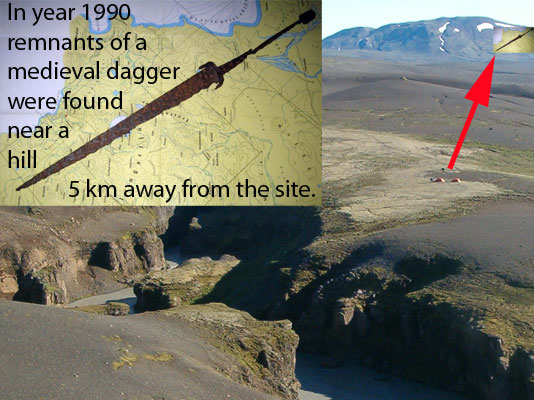
Árið 1990 fundust leifar miðalda bardagahnífs.
Fundarstaðurinn er í 5 km fjarlægð frá vettvangnum.
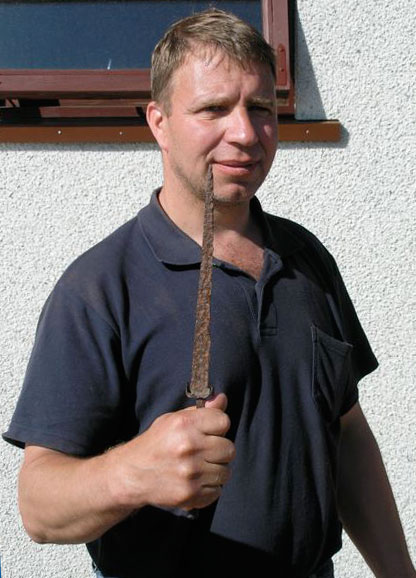
Gunnlaugur Magnússon bóndi í Miðfelli með miðalda riddarahníf
sem hann fann rétt sunnan við Skipholtskrók í smölun haustið1990 eða ´91.
Mynd: Þórarinn Þórarinsson. Gunnlaugur Magnússon is the
farmer who found the medieval dagger
in a sheep roundup in autumn 1990 or 1991. |
* Back to Main
* Table of Contents
* Top of this page |
* Til baka á aðalsíðu
* Til baka í efnisyfirlit
*
Efst á þessa síðu |